An Organizational Fruit Fly
r/place as a model organism for cumulative grounded theory.
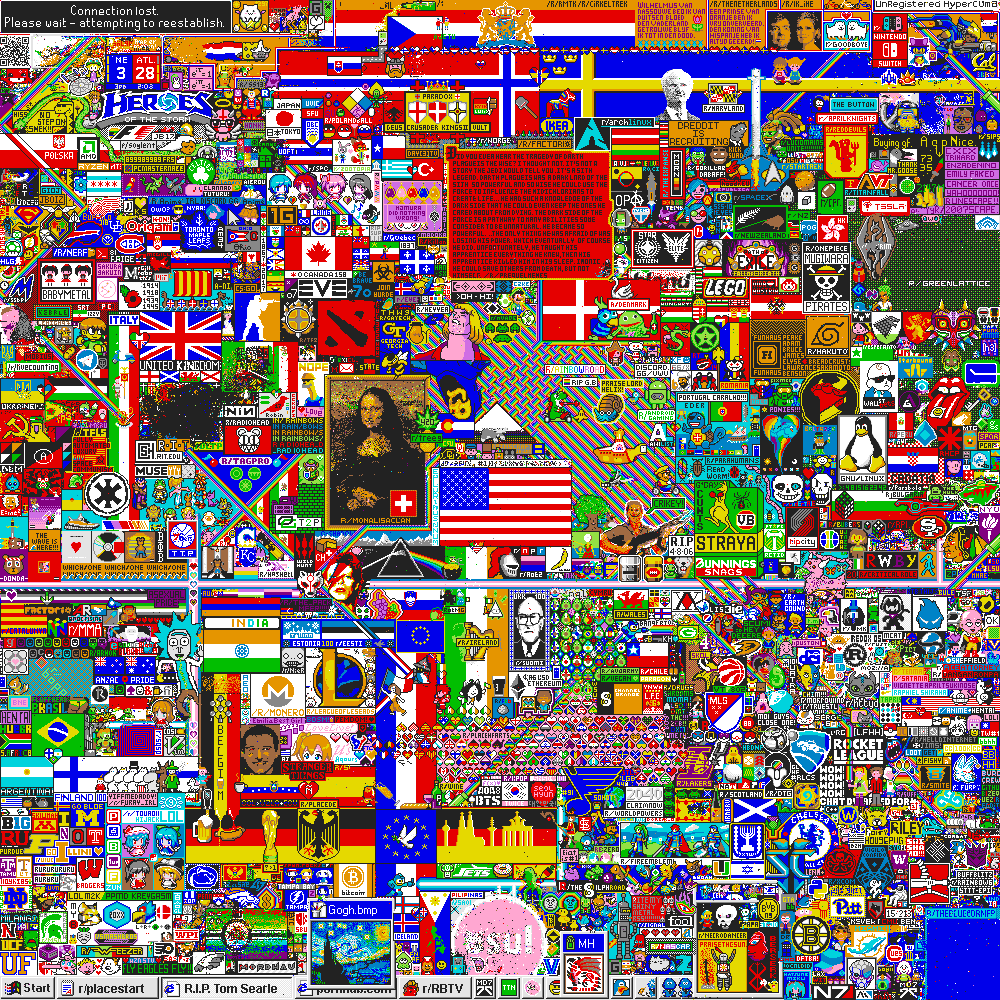
How do communities organize, and why do their forms differ? In 2017, over a million Reddit users made and defended pictures on a shared canvas. We propose this event as a fruit fly for organization science: a common object against which researchers can test explanations and build on what is already known.
The aim is cumulative knowledge: a new explanation should show what it adds to the existing account. The repository joins a frozen dataset with a revisable instrument for reading it. Four features organize this site, applying Ankeny and Leonelli's account of model organisms to this setting.
One shared research object
The record joins pixel changes with posts and comments. Collection scripts reach beyond the current study's 705 curated communities. This study composes their case accounts into a population model while retaining differences between cases. It is a census of the curated population, not every community that discussed the event.
Understand the research object and population.
Common conditions
Communities worked on the same canvas under the same placement rules. Each user could change one pixel every five minutes, and another user could overwrite it. These common conditions make different ways of organizing comparable; they do not make communities identical.
See the shared rules and limits of comparison.
The whole event
The record spans the roughly three-day event, from the first placements to the finished canvas. Posts, comments and pixel changes let us study organizing as it unfolds. The written record also includes the following day. Off-platform coordination remains outside that view.
Explore the event and what the record captures.
Shared data and tools
Collection scripts, coded cases, analysis contracts and saved checkpoints let researchers revisit the same evidence. Community agents code their own records; an aggregator composes a population model and returns it to those agents for corrections. Researchers judge the claims.
The completed run shows what composition can reveal. PlaceNL's defence script erased houses its members had agreed to add. Similar evidence across communities changed the account of repair. Follow the example, its revision and its limits, or question a saved analyst through a checkpoint interview.